The UEFA Champions League quarter-finals 2026 reach their decisive second legs on April 14 and 15, with four ties finely poised and semi-final places on the line.
Bayern Munich return to the Allianz Arena with a 2–1 advantage over Real Madrid, while Arsenal bring a 1–0 lead back to the Emirates against Sporting CP. Barcelona and PSG also look to finish the job away from home after strong first-leg performances against Atlético Madrid and Liverpool respectively, but none of these ties are fully settled.
Second legs are where the tournament’s new format meets old-school knockout tension. With the away-goals rule gone, the focus is now purely on aggregate score: Bayern, Atletico, PSG and Arsenal are in front but still need to manage risk; Real Madrid, Sporting, Liverpool and Barcelona must chase without imploding.
That creates an ideal environment at ibet for smart bets that connect process, context and player usage… exactly the type of spots our handicapping system is built to exploit. And if you like our approach, we got the same kind of insights for niche football leagues like Finland’s Veikkausliiga or even in other sports such as ice hockey and ranging from main stream betting markets such as the Stanley Cup playoffs to Swenden’s SHL betting value.
Champions League Quarter-Finals Promo
Before you lock in these picks, maximize your edge with ibet’s Champions League promotions and sports betting deals. Take advantage of the Champions League Free Bet Challenge tied to the knockout rounds: just place qualifying bets on each quarter-final matchday (minimum odds 1.80) and receive free bets every Thursday!
- Bet €30–€59.99 for €5
- Bet €60+ for €10
You can also protect your positions with ibet’s ACCA Insurance (up to €60 cash back daily) or start earning 5% weekly cashback (up to €200 every Monday). Check the ibet promotions page to access the latest Champions League betting promos and full terms.
If you’re looking beyond the Champions League quarter-finals, including the semi‑finals and outright markets, make sure to explore ibet’s dedicated Champions League betting hub and our betting news blog for data‑driven previews, trends, and prop angles across every matchday.
Champions League Quarter-Finals Tips for First Leg
Here’s what we’re backing for the second legs of the Champions League quarter-finals betting, with full analysis just below:
- Bayern Munich vs Real Madrid: Serge Gnabry Over 0.5 Shots on Target + Harry Kane Over 0.5 Shots on Target + Kylian Mbappé Over 1.5 Shots on Target at 2.33 at ibet
- Arsenal vs Sporting CP: Viktor Gyökeres Over 0.5 Shots on Target + Both Teams To Score – No at 2.32 at ibet
These are not random “fun” bets. They’re built on usage, xG profiles, tactical matchups, and expected game scenarios in two of the most compelling ties of the round.
Champions League Quarter-Finals Fixtures (Second Leg)
Tuesday, April 14, 2026
- Atlético Madrid vs Barcelona — Metropolitano, Madrid | 21:00 CET
- Liverpool vs Paris Saint-Germain — Anfield, Liverpool | 21:00 CET
Wednesday, April 15, 2026
- Arsenal vs Sporting CP — Emirates Stadium, London | 21:00 CET
- Bayern Munich vs Real Madrid — Allianz Arena, Munich | 21:00 CET
Champions League Quarter-Finals Best Bets
Bayern Munich vs Real Madrid
Wednesday, April 15, 2026, at 21:00 (CET) — Allianz Arena
Champions League Pick: Serge Gnabry Over 0.5 Shots on Target + Harry Kane Over 0.5 Shots on Target + Kylian Mbappé Over 1.5 Shots on Target at 2.33 with ibet
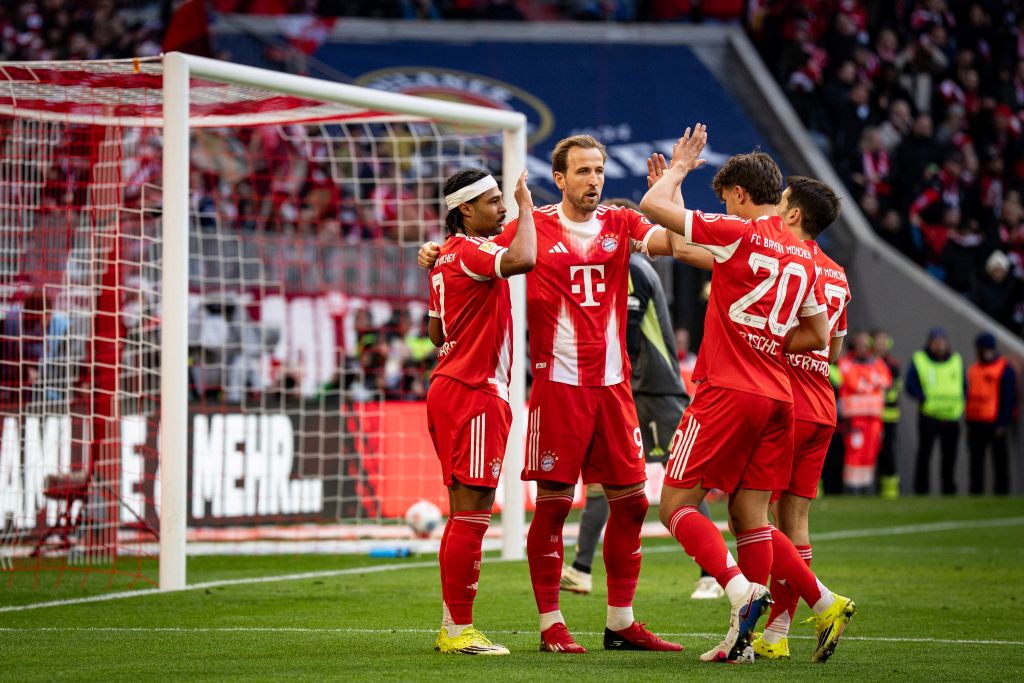
Bayern bring a 2–1 lead home from the Bernabéu after an impressive away performance, and everything about this second leg points toward a high-shot environment for both attacks. Bayern have been relentless at the Allianz all season, boasting a perfect Champions League home record and averaging over three goals scored per UCL home match.
Real Madrid, meanwhile, must find at least one away goal to have any chance of advancing, and with Thibaut Courtois and Aurélien Tchouaméni missing, they are structurally set up to both concede chances and lean heavily on Kylian Mbappé’s shot volume.
From a player-usage perspective, all three legs are conservative relative to each player’s baseline. Serge Gnabry has 50 shots in 21 Bundesliga games this season, with 17 on target. That’s roughly 3.66 shots and 1.2 shots on target per 90 minutes, meaning “Over 0.5 SOT” is cleared in a typical outing.
Harry Kane is even more volume-heavy: across domestic play he has taken 108 shots with roughly 56–61 on target, and StatMuse lists his Bundesliga rate at 2.35 shots on target per game in 2025–26. In other words, asking each Bayern forward for just one shot on target in a must-score second leg at home is comfortably within their normal distribution, not a ceiling outcome.
On the Otherside
Mbappé’s leg is more aggressive but backed by elite numbers and game state. In La Liga this season, he has 119 shots and 57 on target in 26 games. That’s about 4.8 shots and 2.2 shots on target per match. In the Champions League, he’s been hitting at least 2 shots on target in 8 of 10 games this season, including 4 on target in the first leg against Bayern.
Real’s entire attacking plan in Munich runs through him and Vinícius: with Rodrygo still out and Tchouaméni suspended, more responsibility falls on Mbappé to both create and finish. Your system’s player-prop module (role, minutes, usage, game state) flags this as exactly the kind of spot where 1.5 SOT is a realistic median rather than a stretch, especially once Real inevitably have to push numbers forward.
Correlation is what really makes this combo coherent rather than random. The same scripts in which Bayern play to their home strengths like high tempo, sustained pressure, lots of crosses and cutbacks, are the scripts in which both Gnabry and Kane naturally produce shots on target.
Likewise, any Bayern goal deepens Real’s urgency, forcing them to open up and further increasing Mbappé’s shot volume as he attacks space behind Bayern’s back line. Even if the match stays tense at 0–0 for a while, Bayern’s process usually generates on-target efforts from their two main finishers, and Real can’t be passive for 90 minutes when they trail on aggregate.
At 2.33, you are effectively being paid as if one of these three low bars fails far more often than the data and game-state logic suggest.
Arsenal vs Sporting CP
Wednesday, April 15, 2026, at 21:00 (CET) — Emirates Stadium
Champions League Quarter-Finals Pick: Viktor Gyökeres Over 0.5 Shots on Target + Both Teams To Score – No at 2.32 with ibet
At first glance, combining a Sporting player’s shot prop with BTTS: No might look contradictory, but your system’s defensive and finishing layers show why this is a reasonable, correlated position.
Arsenal return to London with a 1–0 aggregate lead after a mature away performance in Lisbon: they had 58% possession, outshot Sporting 9–7, put 5 attempts on target versus 3, and won it late through Kai Havertz in stoppage time. Across the Champions League season, Arsenal have conceded only 4 goals in 8 league-phase games and have repeatedly suppressed opponents’ xG through compact shape, aggressive pressing and excellent goalkeeping from David Raya.
That defensive profile is exactly what you need for this pick. Controlled shot suppression, few clear looks, and a keeper capable of “goals prevented” above expectation.
Weak Attack
Sporting’s attack is notably weakened for this second leg. They are without Morten Hjulmand (suspended), Fotis Ioannidis, Nuno Santos, Geovany Quenda and Luís Guilherme, trimming both their midfield protection and attacking rotation options. Away from the Alvalade, they are unlikely to enjoy the same territorial comfort and emotional momentum that powered earlier comebacks.
Our situational model therefore sees a realistic path to an Arsenal clean sheet: a strong defensive unit, at home, facing an opponent forced to chase but missing several key creative and finishing pieces. A 1–0 or 2–0 Arsenal win aligns well with both their season-long numbers and the aggregate context.
Where Viktor Gyökeres comes in is on the usage side, not the finishing side. This season, in Champions League play, he’s averaging 1.33 shots on target per game (12 on target in 9 matches), and in domestic competition he routinely clears the 0.5 SOT bar thanks to high shot volume and central role. Best part is we don’t need Gyökeres to score, only to test the goalkeeper once. In a quarter-final second leg where he is either the primary focal point for Sporting’s rare attacks or Arsenal’s main striker in a high-xG home setup, one shot on target is a very modest requirement.
The Pick
Crucially, a single on-target effort for Gyökeres is perfectly compatible with BTTS: No. The first leg already showed that Sporting can generate 3 shots on target without scoring when facing Raya and Arsenal’s low-xGA structure. At the Emirates, Arsenal’s defence should be even more comfortable, but they are unlikely to limit Sporting to zero shots on target; if any decent look falls to Sporting’s best finisher, that’s where Gyökeres’ leg cashes.
From your system’s angle, the most probable clean-sheet scenarios are ones where Arsenal concede a small number of low-to-medium quality attempts rather than absolutely none. That’s the exact window in which Gyökeres goes 1 SOT, 0 goals, while Arsenal do enough at the other end to win to nil. At 2.32, you’re being paid as if either Arsenal’s clean-sheet probability is much lower than your defensive model suggests, or Gyökeres’ on-target baseline doesn’t carry into a high-stakes second leg.
Both look conservative when you line up the numbers with the likely game script.
Champions League Quarter-Finals Recap: How We Got Here
To fully appreciate these Champions League quarter-finals, it helps to look at how each of the eight remaining teams punched their ticket in the round of 16.
This stage was anything but cagey: Bayern Munich produced a 10–2 aggregate demolition of Atalanta, PSG overwhelmed Chelsea 8–2 over two legs, Barcelona brushed aside Newcastle 8–3, and Real Madrid calmly dispatched Manchester City 5–1 on aggregate. Sporting CP and Liverpool delivered two of the most dramatic turnarounds of the round.
Meanwhile, Sporting overturned a 3–0 first‑leg deficit against Bodø/Glimt with a 5–0 extra‑time hammering in Lisbon, while Liverpool responded to a 1–0 loss in Istanbul by smashing Galatasaray 4–0 at Anfield to win 4–1 overall. Arsenal did what elite sides are supposed to do in this format, following up a 1–1 away draw at Bayer Leverkusen with a controlled 2–0 home win to advance 3–1 on aggregate.
How the Champions League Quarter-Finals Work & Why First Legs Matter
Under the new format, the Champions League quarter-finals are still played over two legs, home and away. The team with the better aggregate score advances to the semi‑finals; if the aggregate is level after 180 minutes, the tie goes to extra time and penalties if needed. Importantly, the away‑goals rule has been abolished, so goals scored away from home no longer carry extra weight in tiebreakers—though the psychological value of scoring on the road remains very real.
First legs tend to have their own tactical ecosystem. Managers want an advantage, but not at the cost of losing the tie inside 90 minutes. Sides at home in the first leg often press to establish a lead while still guarding against giving up cheap transitions; teams away in the first leg know they will host the return and can live with narrow defeats or draws. From a betting perspective, this often means slightly lower raw scoring than the talent would suggest in some ties, but in others, like Barcelona vs Atlético or PSG vs Liverpool, it means controlled chaos: enough aggression to produce goals, but not the all‑out abandon you see in desperate second legs.
Betting Strategy & What to Watch in the Quarter-Finals
In second legs, context is everything. Sides with aggregate leads and strong underlying process (Bayern, Arsenal, PSG, Barcelona) often offer less value on short moneyline prices but more value in team-specific markets like team totals, corners and props on their primary shot-takers.
Trailing teams with elite individuals (Real, Liverpool, Atlético) can be better approached through shots, shots on target and anytime-scorer markets rather than 1X2 if their defensive profiles look fragile.
Your system also emphasizes that second legs are fertile ground for defensive-workload and discipline props. Teams chasing the game push more players forward and leave themselves exposed, increasing tackles and clearances for the leading side’s defenders, and raising card risk for midfielders forced into tactical fouls.
Conversely, favourites protecting a lead sometimes adopt a more compact shape and focus on denying central space, which can lower opponent xG without eliminating shot volume entirely. That’s precisely the pattern targeted in the Gyökeres + BTTS: No combo. The most profitable bets at this stage are the ones that connect those tactical truths to specific markets, rather than just guessing who “wants it more.”
Champions League Quarter-Finals FAQ
Are the Champions League quarter-finals two legs?
Yes. The Champions League quarter-finals are two‑legged ties. Each matchup is played home and away, and the team with the better aggregate score over the two matches advances to the semi‑finals. If the aggregate score is tied after both legs, the tie goes to extra time and, if necessary, penalties. The away‑goals rule has been abolished, so away goals no longer provide an automatic tiebreak advantage.
When are the Champions League quarter-final second legs played?
The second legs of the 2025–26 Champions League quarter-finals are played on Tuesday, April 14, 2026 (Atlético vs Barcelona, Liverpool vs PSG) and Wednesday, April 15, 2026 (Arsenal vs Sporting CP, Bayern Munich vs Real Madrid), with all matches kicking off at 21:00 CET.
How are quarter-final matchups decided?
Quarter-final matchups are determined by a draw held after the round of 16, with no seeding or country protection—meaning clubs from the same league can face each other and previous opponents can be drawn again. The draw also fixes the order of home and away legs. The evolution of the 36‑team league phase and playoff rounds determines who reaches this stage, but once you’re in the quarter-finals, it’s a pure open draw.
All odds displayed on this page were correct at the time of writing and may have moved since the content was published. Betting markets shift constantly based on action and betting news. For the latest odds and current lines, visit the ibet Sportsbook.