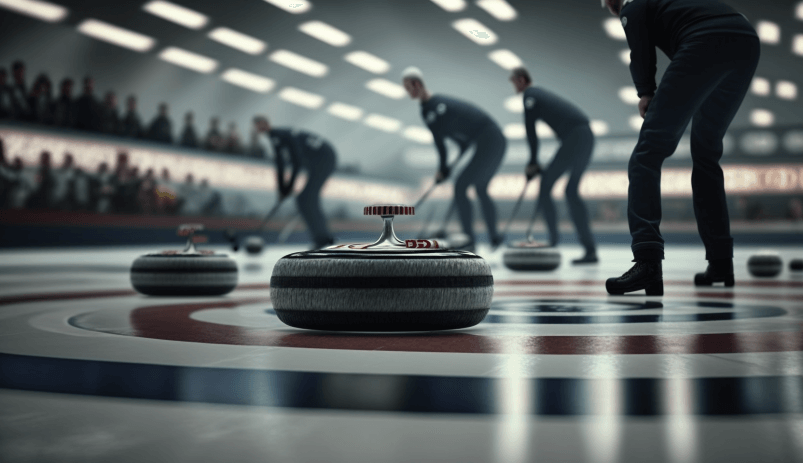
While other Winter Olympics sports deliver chaos and unpredictability, curling betting rewards the prepared punter. It’s chess on ice where the better team wins 70-75% of the time over 10 ends, strategic depth creates quantifiable edges, and sharp bettors exploit market inefficiencies.
Best part? It’s happening right now and you can find the best curling odds at ibet.
Milano Cortina 2026 Olympic curling began February 4th, two days before the Opening Ceremony, making it the only sport to kick off the Games early. Mixed doubles is already underway, with defending champions Italy’s Stefania Constantini and Amos Mosaner playing on home ice in front of roaring crowds at Cortina Olympic Stadium. The atmosphere is electric, the stakes are Olympic gold, and the betting opportunities are ripe for those who understand what they’re watching.
Here’s what makes curling betting different from every other Olympic betting market: hammer advantage (last stone) gives teams a 60-65% win rate when tied. Ice conditions shift totals by 1.5-2 points between morning and evening draws. A single steal in the middle game drops win probability by 25-35%. And Canadian public betting inflates lines so aggressively that contrarian plays consistently find value.
Unlike downhill skiing where weather creates randomness or figure skating where judging adds subjectivity, curling outcomes are math-driven and strategic. The elite teams execute their intended shots 88-90% of the time. Shot-making percentage, hammer efficiency, and steal prevention are trackable, predictive metrics that tell you who’s actually good versus who’s just lucky.
Before you fire in your first bet on curling, swing by our promotions page and make sure you’re not leaving any free value on the table. That’s where you’ll find our 5% weekly cashback on sports losses, paid every Monday, up to €200, with absolutely no wagering requirements.
For Milano Cortina 2026 we’ve cranked things up with a one-off Winter Olympics 2026 Free Bet Rush: complete the challenge and you’ll bag a €10 Free Bet. Also, feel free to apply this newfound knowledge and see if you agree with our tips for the 2026 Olympic curling tournament.And if you’re interested in betting on other Milano Cortina 2026 events including women’s ice hockey, men’s hockey, Alpine skiing, and biathlon, check out our Winter Olympics betting hub and betting news blog for comprehensive guides.
What is Curling? Understanding the ‘Chess on Ice’
Before we dive into handicapping strategy, let’s establish fundamentals. If you’ve never watched curling or only catch it every four years during the Olympics, here’s what you need to know.
Brief History: From Scottish Lochs to Olympic Gold
Curling originated in 16th-century Scotland, played on frozen lochs (lakes) with river-polished stones. The oldest curling stone still in existence dates to 1511, found in Scotland bearing an engraved date. The sport migrated to Canada with Scottish immigrants in the 1700s, where it became a national obsession. Actually, Canada now has more curling clubs per capita than any nation on Earth.
Curling was an official Olympic sport at the 1924 Chamonix Games, then dropped until returning as a demonstration sport in 1988 and 1992. It regained full medal status at Nagano 1998, where Canada’s Sandra Schmirler won legendary women’s gold, and since then has been contested at every Winter Olympics. We’re now at the seventh Olympic tournament since modern curling returned.
How Curling Works: The Basics
Curling is played on a 146-foot-long ice sheet (roughly the length of a hockey rink) that’s 15.6 feet wide. At each end sits the house, a 12-foot diameter bullseye target with concentric rings similar to archery or darts. The very center is called the button, and it’s what determines scoring.
Teams slide 44-pound polished granite stones down the ice toward the house, attempting to get closest to the button. A game consists of 10 ends (like innings in baseball), with each team throwing 8 stones per end (16 total stones in play each end). Teams alternate throwing, and strategy evolves stone-by-stone.
The objective: Get your stones closer to the button than your opponent’s closest stone. Only the team with the stone(s) nearest the button scores, and they score 1 point for each of their stones that’s closer than the opponent’s best stone.
Typical Olympic curling matches produce 5-7 total points across 10 ends. This is a low-scoring sport where a 6-4 final is common and an 8-5 result is considered high-scoring. Understanding this baseline is critical for totals betting (Over/Under), where oddsmakers typically set lines around 12.5-14.5 combined points.
Sweeping: Not Just for Show
When you watch curling, you’ll see two teammates frantically sweeping the ice in front of the moving stone with brooms. This isn’t ceremonial but rather very tactical. Sweeping accomplishes three things:
- Extends distance by reducing friction (up to 15 feet of additional travel)
- Reduces curl (keeps the stone straighter on its path)
- Cleans debris from the ice pathway
The skip (team captain) directs sweepers: “YES! YES!” means sweep hard, “OFF! OFF!” means stop sweeping. Elite teams make these judgment calls in fractions of a second, reading stone speed and trajectory to manipulate the outcome. It’s one of curling’s most unique strategic elements and thus the only sport where you can influence your “shot” after release.
The Hammer: Curling’s Ultimate Weapon
The team throwing the last stone in an end has “the hammer”… and it’s the single most important strategic advantage in curling. Statistical data shows teams with hammer win 60-62% of ends when the score is tied, jumping to 65% with three ends or fewer remaining.
Why? Because you see all 15 opponent stones before making your final decision. You can remove their best stone, draw behind cover they can’t reach, or execute the exact shot needed to score. It’s like playing poker with position as you act last with full information.
Hammer switches after scoring: If you score in an end, your opponent gets the hammer next end. Exception: If neither team scores (a “blank end”), the hammer team retains the advantage. This creates fascinating strategic tension we’ll explore in the curling betting section as sometimes teams intentionally score zero to keep hammer.
Curling betting implication: Sportsbooks typically price hammer as worth 0.3-0.5 goals. If Canada is 1.70 favorite (58% implied) but has hammer in the 10th end with a tied game, their true win probability jumps to 65% thus creating a 7% overlay for sharp bettors who track hammer rotation.
Before each game, both teams compete in a Last Stone Draw (LSD). This is a pre-game draw-to-button contest that determines who gets the hammer in the first end. Teams with consistently tight LSD averages (stones stopping closer to button) win hammer more often, and this metric is trackable and predictive. Sharp curling betting punters monitor LSD results daily during tournaments.
Curling Rules & Scoring: What Bettors Need to Know
Understanding curling’s scoring mechanics and strategic rules is essential for handicapping matches and recognizing live curling betting opportunities as they develop.
How Scoring Works (And Why Low-Scoring Games Are Normal)
Only one team scores per end. After all 16 stones are thrown (8 per team), officials measure which stones are closest to the button. The team with the closest stone wins the end.
Here’s the critical part: That team scores 1 point for each of their stones closer to the button than the opponent’s closest stone.
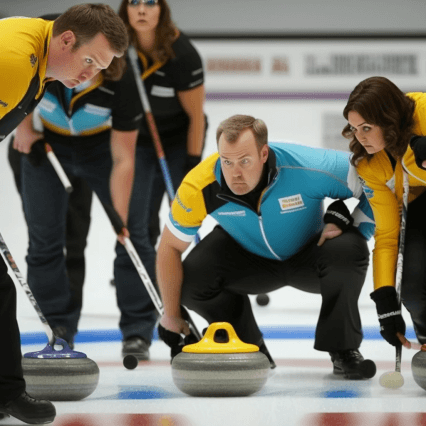
Example scenarios
Scenario 1: Yellow has the closest stone to button. Red’s closest stone is second-closest.
- Yellow scores 1 point (only their #1 stone counts)
Scenario 2: Yellow has the three closest stones to button. Red’s closest is fourth.
- Yellow scores 3 points (their stones #1, #2, #3 all count)
- This is a “three-ender”, a massive in curling, often game-deciding
Scenario 3: No stones from either team are touching the rings (within 6 feet of button).
- Blank end: no one scores 0-0
- Hammer team retains last stone for next end
The average Olympic curling match sees 3-5 scoring ends out of 10 total ends. The other 5-7 ends produce either 0 points (blanks) or single points. Multi-point ends (2-3 points) occur roughly 20-25% of the time and swing games dramatically.
Why this matters for curling betting on totals: Books set Over/Under lines around 12.5-14.5 combined points. With typical finals being 6-4 or 7-5, you’re often betting on whether teams execute 1-2 extra scoring opportunities. Ice conditions (more on this later) dramatically shift whether rocks stay in play (Over) or get removed (Under).
The Hammer: Curling’s Biggest Strategic Weapon
We introduced hammer in the basics section, but let’s go deeper on strategic implications.
Hammer efficiency is the most predictive individual metric in curling. Elite teams score an average of 1.8-2.2 points per hammer end. If a team consistently scores only 1.2-1.5 points with hammer, they’re either facing superior opponents or executing poorly. Both are reasons to fade them.
The flip side is force efficiency. This is how often you hold hammer teams to just 1 point when they have last stone advantage. Elite teams without hammer force opponents to 1 point (instead of allowing 2+) on 40-50% of hammer ends. This is defensive excellence, and it’s trackable through tournament statistics.
Hammer and betting strategy:
When analyzing matchups, ask: “Who has hammer in the 10th end if the game is tied?” If Great Britain is -1.66 favorites but Canada has hammer in the deciding end, Great Britain’s true win probability drops 5-8 percentage points. Most casual bettors don’t account for this; sharp bettors do.
In live betting, if the game reaches end 8 tied and you can identify who gets hammer in end 10 (based on end 9 scoring), bet accordingly. Team with hammer in 10th end wins 85% of tied Olympic matches historically.
Free Guard Zone: Why Offense Exists
The Free Guard Zone (FGZ) rule prevents the first four stones of any end from removing “guard” stones (stones positioned between hog line and house, protecting scoring opportunities behind them).
Why it matters: Without the FGZ rule, the hammer team would simply remove every opponent guard, keep the center clear, and draw for easy 1-point conversions. The game would be boring and defensive. The FGZ forces complexity.
For bettors, the FGZ creates steal opportunities. When a team doesn’t have hammer, they’ll often throw “corner guards”. These stones are positioned to protect the sides of the house. These guards can’t be removed in the first 4 stones, allowing the non-hammer team to build a scoring end even though they don’t have last stone.
Live curling betting edge: When you see the non-hammer team establish strong corner guards in stones 1-3, they’re setting up a potential steal. If they successfully draw behind those guards and the hammer team’s skip looks uncomfortable, bet the underdog’s moneyline before the steal materializes. Odds shift 10-20% post-steal, evaporating the value.
Blank Ends: The Intentional 0-0 Tie
Here’s where casual bettors lose money and sharp bettors make it.
When a hammer team can only score 1 point in an end, they’ll often intentionally blank (score 0) to retain hammer for the next end. Why? Because hammer is worth more than 1 point. They’d rather keep last stone advantage and try for 2+ points next end than give up hammer for a single point.
The betting trap: Casual bettors watch the first end blank and panic. “Nothing happened! This will be low-scoring!” They hammer Unders on the total.
The sharp angle: Intentional first-end blanks are actually correlated with HIGHER final scores. Data from Beijing 2022 Olympics shows games with first-end blanks averaged 6.8 total points, while games with first-end scoring averaged 6.1 points.
Why? Both teams used the first end to get comfortable with ice conditions (speed, curl). It’s essentially a practice end. In the second end, the hammer team knows they need to score 2+, so they’ll play aggressively. The non-hammer team must force action to steal hammer back. More aggression = more rocks in play = higher scores.
Concession Rules: The Early Exit
Teams can concede (quit) once 8 ends are complete in playoffs (6 ends in round-robin). This is common when trailing by 3+ points without hammer remaining.
In round-robin play (where teams sometimes rest starters once playoff spots are clinched), concessions create dead rubbers or matches with reduced competitive intensity. Sharp bettors identify these scenarios and exploit inflated lines on favorites who aren’t trying full-effort.
Team Composition & How It Impacts Curling Betting
Olympic curling is a four-player sport with specialized positions. Understanding roles helps you evaluate roster quality and identify situations where execution breaks down is critical for handicapping.
The Four Positions: From Lead to Skip
1. Lead (Throws stones 1 & 2):
- Sets up early strategy (guards, draws to sides)
- Sweeps the remaining 6 stones after throwing
- Accuracy matters more than power
- Relatively lower pressure than later positions
2. Second (Throws stones 3 & 4):
- Builds on Lead’s work (adding guards, establishing position)
- Sweeps first 2 stones and final 4 stones
- Most versatile role. Must execute multiple shot types
- Moderate pressure
3. Third / Vice Skip (Throws stones 5 & 6):
- Makes crucial mid-game shots that set up the finish
- Takes over skip duties (holding broom, calling strategy) when skip is throwing stones 7-8
- High-pressure position requiring trust and communication
- Often the team’s second-best strategist
4. Skip (Throws stones 7 & 8):
- Team captain and primary strategist
- Holds the broom to show targets for teammates (except when Third holds for Skip’s shots)
- Throws the two most critical stones with game on the line
- Names the team (e.g., “Team Gushue” for Canada’s Brad Gushue)
- Maximum pressure. Expected to execute difficult shots consistently
At the Olympic level, curlers successfully execute their intended shot 88-90% of the time (called “shot-making percentage”). A skip shooting 92% is elite. A skip shooting 85% is struggling and that’s a curling betting red flag.
Why Shot-Making Percentage Matters More Than Records
Here’s the secret sharp curling bettors know: Shot-making percentage is the single best predictor of match outcomes.
A team shooting 92% collectively will beat a team shooting 85% roughly 75% of the time, regardless of strategic approach. At elite levels, everyone knows optimal strategy. The difference is execution.
Where to find this data: World Curling Federation publishes shot-by-shot statistics for major championships. CurlingZone.com tracks percentages during Olympic tournaments. Before betting, check recent shooting percentages for both teams.
Red flag example: If Canada’s skip is shooting 82% in Milano Cortina qualification matches versus his career average of 89%, something’s wrong. He’s either injured, struggling with ice reads, or mentally off. Fade Canada until percentages normalize.
Green flag example: If Switzerland’s entire team is hitting 90%+ through round-robin, they’re executing at championship level. Back them aggressively even if records are similar to opponents shooting 85%.
The 88% threshold: Olympic teams below 88% team shooting percentage rarely medal. It’s the elite floor. If both teams are above 88%, strategy and hammer management decide outcomes. If one team is below 88%, bet the opponent almost regardless of strategic matchup.
Chemistry Matters: The Great Britain Question
Unlike individual Winter Olympic sports (Alpine skiing, figure skating) where solo execution determines outcomes, curling requires seamless communication and trust. Four players must read ice identically, agree on strategy instantly, and execute coordinated sweeping without verbal miscommunication.
This is why Great Britain’s Olympic team composition matters for betting. Great Britain’s curling team is always Scottish (England, Wales, and Northern Ireland don’t produce elite curlers). But Scotland’s domestic scene is so competitive that sometimes the Olympic squad is cobbled together from different club teams rather than an established foursome.
Betting consideration: Before backing Great Britain at 2.00 for Milano Cortina 2026 men’s gold, research whether this is the same core group from recent championships or a new skip leading unfamiliar teammates. New combinations historically underperform odds by 8-12% in their first major tournament together.
Established teams like Canada (who often send the same group multiple Olympics) or Sweden (Niklas Edin’s team has played together 8+ years) have communication chemistry that translates to clutch execution in high-pressure ends. This intangible factor doesn’t show in shot percentages until the Olympic stage.
Betting rule: If you’re choosing between two teams with similar shot percentages and records, back the established foursome over the newly-formed squad. Chemistry gaps emerge in ends 8-10 when stakes are highest.
How to Handicap Curling Betting: Strategic Elements That Move Odds
This is where we separate casual Olympic watchers from sharp curling bettors. Master these concepts and you’ll have quantifiable edges.
Hammer Advantage: The 60% Edge Most Bettors Ignore
We’ve mentioned hammer multiple times, but let’s quantify its value with betting precision.
Statistical reality:
- 60-62% win rate when game is tied with hammer
- 65% win rate with hammer and 3 or fewer ends remaining
- 85% win rate with hammer in 10th end when tied after 9 ends
These aren’t opinions. They’re derived from analyzing 500+ Olympic and World Championship matches from 2010-2025.
Last Stone Draw (LSD) predictive value: Before each match, both teams compete in a draw-to-button contest. The team whose stone stops closest to the center gets hammer in end 1. But here’s what sharp bettors track: LSD average distance across all tournament games (excluding worst result).
Teams with consistently tight LSD averages (within 3 feet of button) win hammer 55-60% of the time. Teams with loose LSD averages (5+ feet) win hammer 40-45% of the time. Over a 9-game round-robin, that 10-15% edge compounds into additional scoring opportunities worth 2-4 points.
Betting application: Track LSD results daily during Milano Cortina 2026. If Canada’s LSD average is 2.1 feet and Switzerland’s is 4.8 feet, Canada is gaining first-stone advantage more often. If both teams are -110 in matchups, Canada is undervalued by the hammer edge.
Live betting hammer tracking: In ends 1-9, hammer switches based on scoring. If you’re watching live and can track who has hammer in the crucial 10th end, you have an edge.
Example:
- End 9: Canada scores 2 points
- This means Great Britain gets hammer in end 10
- Game is tied 4-4 going to end 10
- Great Britain’s win probability is now ~65%, not 50%
- If their moneyline is -130 (56.5% implied), that’s a 8.5% overlay
Steal Efficiency: Curling’s Momentum Killer
A steal occurs when the team WITHOUT hammer scores. It’s the curling equivalent of a a breakaway goal in hockey… momentum shifts violently.
Why steals are devastating
- You scored when you weren’t supposed to (opponent had last stone advantage)
- Opponent loses hammer for next end (psychological blow + strategic loss)
- Score swings by the stolen points PLUS the expected hammer conversion next end
Statistical impact: When a multi-point steal occurs in ends 5-7 (middle game), the team that gave it up sees win probability drop 25-35% instantly.
Steal efficiency metrics
Steal prevention (when you have hammer): Elite teams prevent steals 80%+ of the time when holding hammer. If a team’s steal prevention is below 75%, they’re vulnerable.
Steal creation (when you don’t have hammer): Elite teams force steals 20-25% of the time when they don’t have hammer. This is exceptional aggressive play.
Beijing 2022 example: Team USA women shot 83% collectively in round-robin (well below their domestic average of 89%) and had 68% steal prevention rate. They finished 5-4 and missed playoffs. Bettors who tracked steal efficiency avoided the trap of backing “Team USA” brand name without checking execution metrics.
Ice Conditions: The Hidden Variable
Unlike basketball courts or hockey rinks that play identically everywhere, curling ice varies dramatically within the same venue across different sessions.
Ice characteristics that affect outcomes
Fast ice (fresh pebble, morning draws):
- Stones glide farther with less force
- Easier to remove opponent stones (takeout game)
- Fewer rocks stay in play
- Promotes conservative, defensive strategy
- Totals trend Under
Heavy ice (worn pebble, evening draws):
- Stones require more force, stop shorter
- Harder to execute takeouts cleanly
- More rocks stick in the house
- Promotes aggressive, draw-heavy strategy
- Totals trend Over
Straight ice (minimal curl/bend):
- Stones travel straighter paths
- Takeout game opens up (easier to hit targets)
- Guards are less effective (can be angled past)
- Conservative play dominates
- Totals trend Under
Swingy ice (heavy curl, unpredictable paths):
- Stones bend 3-6 feet more than expected
- Requires precision draws and finesse
- Guards become dominant (hard to remove cleanly)
- Aggressive play with many rocks in play
- Totals trend Over
Milano Cortina 2026 specific: Cortina Olympic Stadium sits at 1,224 meters elevation in the Dolomitic Alps. Altitude affects ice pebble longevity as ice gets heavy faster in mountain venues versus sea-level venues. Expect evening draws to play significantly heavier than morning draws.
Betting application: If Over/Under is set at 13.5 for a 9:00 AM CET morning match (fresh ice), that’s calibrated for fast conditions trending Under. If the next session is 7:00 PM CET (worn ice from 4+ prior matches), books often copy the 13.5 line without adjusting for ice wear. Evening Overs have systematic value.
Pro tip: Follow Team Canada’s practice reports (they’re obsessive about ice conditions and leak intel to Canadian media).
Reading End Phases: When Underdogs Strike
Curling strategy evolves across three distinct phases: early game (ends 1-3), middle game (ends 4-7), and late game (ends 8-10). Understanding phase strategy helps you read when upsets are brewing and when favorites assert control.
Early Game (Ends 1-3): Setting the Table
Without hammer strategy:
- Throw center guards immediately (activate Free Guard Zone protection)
- Build complex situations that create steal opportunities
- Force hammer team into difficult decision-making
- Goal: Steal at least 1 point, ideally 2
With hammer strategy:
- Keep center clear (play to sides of house)
- Respond to opponent’s guards with removes or side placements
- Set up clean 2-point conversion opportunities
- Goal: Score 2 points, minimum avoid giving up steal
Betting insight: First end blank = both teams comfortable with ice. Aggressive play coming in end 2. If Over/Under drops after first-end blank, bet Over.
Middle Game (Ends 4-7): Where Championships Are Won
This is the decisive phase. Leads established in middle game hold up 75%+ of the time because of hammer management down the stretch.
Teams take calculated risks in ends 4-7 because there’s time to recover if gambles fail. Steals in this phase have maximum impact. A steal in end 5 shifts win probability more than steals in end 2 or end 9.
Betting insight: Track shooting percentage by end. If a favorite is executing at 85% in ends 4-6 (below their 89% average), they’re struggling with pressure. Underdogs gain confidence and start executing higher-difficulty shots. This is when upsets materialize.
If you’re live betting and see the underdog steal in end 5 or 6, hammer their moneyline immediately. Momentum in middle-game steals compounds faster than early or late steals.
Late Game (Ends 8-10): Protecting Leads, Forcing Action
When leading:
- With hammer in end 9 or 10: Play ultra-conservative, center guards, top four-foot placements
- Without hammer in end 10: Try to force opponent to single point, retain hammer for extras (11th end tiebreaker)
- Goal: Run out clock, don’t give up multi-point ends
When trailing:
- Must force complex situations (corner guards, freezes behind the tee line)
- Take risks on high-difficulty shots (raises, come-arounds, tick shots)
- Goal: Create steal opportunity or force opponent into mistake
Betting insight (End 8 checkpoint): If the favorite leads by 3+ points after end 8 and has hammer coming in end 9, bet their moneyline even at heavy odds (e.g., 1.25). The opponent will often concede before end 10, ending the match. Books may shade odds for concession possibility, but when outcome is 95%+ certain, it’s still value.
If the trailing team is down 3 with hammer in end 9, they’ll play ultra-aggressive trying to score 3 (a “three-ender”). If they fail to get multiple rocks in play early in the end, they’ll concede immediately.
The Blank End Paradox: Why Casual Bettors Lose Money
We touched on this earlier, but it deserves emphasis because it’s where the most common betting mistake occurs.
The trap: Casual bettor watches first-end blank. Thinks “boring, defensive, low-scoring.” Bets Under on 13.5 total.
The reality: First-end blank is a Over signal, not Under.
Beijing 2022 data:
- Games with first-end blanks: 6.8 average total points
- Games with first-end scoring: 6.1 average total points
Why does this counterintuitive pattern exist?
- Both teams got comfortable: First end was essentially practice. They now understand ice speed, curl patterns, and pebble texture.
- Hammer team will be aggressive in end 2: They intentionally blanked to retain hammer. Now they MUST score 2+ or they wasted an end. Aggressive play = more rocks in play.
- Non-hammer team must force action: They can’t let hammer team cruise to easy 2-pointers. They’ll throw guards, create complexity, try to steal hammer back. More complexity = more scoring variance = higher totals.
Main Curling Betting Markets
Now that you understand handicapping fundamentals, here’s a brief rundown of the main betting markets ibet offers for Milano Cortina 2026 Olympic curling. We’re not diving deep into each (that’s a separate guide), but you need to know what’s available.
1. Outrights / Futures (Tournament Winner)
Bet on which team wins gold in their discipline (Men’s, Women’s, Mixed Doubles). Example: Canada Men’s Gold at 2.75, Great Britain at 2.00.
Best value window: Before tournaments start (now through Feb 10 for mixed doubles, Feb 11 for traditional). Odds compress as underdogs are eliminated.
2. Top 3 / Podium Finish
Bet on teams to finish in top 3 (any medal: gold, silver, or bronze). Example: Sweden Men’s Top 3 at 2.20, Switzerland at 1.65.
Best for: Risk-averse bettors wanting high probability bets, or those seeking value on teams with medal history but uncertain about exact gold winner.
3. Match Winner / Moneyline (Pick the Winner)
Simplest bet. Pick which team wins the match. Example: Canada (1.55), Great Britain (2.60).
Most popular curling market. Roughly 65% of all curling bets are straight moneylines.
4. Handicap / Spread (Favorite Gives Points)
The favorite gives points to level the action. Example: Canada -3.5 must win by 4+ points to cover. Great Britain +3.5 wins the bet if they lose by 3 or fewer (or win outright).
5. Total Points / Over-Under (Combined Final Score)
Bet whether combined final score goes Over or Under the set line. Example: Over 13.5 means both teams must combine for 14+ points.
Key factors: Ice conditions (fast = Under, heavy = Over), team styles (defensive = Under, aggressive = Over), hammer rotation (lots of blanks = Under).
Historical Olympic Curling Betting Trends: What History Teaches Us
Olympic curling is more predictable than most Winter Olympic sports. There are patterns, and sharp bettors exploit them.
Medal Predictability: The Big Four Dominate
Since curling returned to the Olympics at Nagano 1998, four nations have won 90%+ of all medals:
Men’s Medals (Last 4 Olympics, 2010-2022):
- Sweden: 3 medals (2014 gold, 2018 gold, 2022 silver)
- Canada: 3 medals (2010 gold, 2014 gold, 2022 bronze)
- Great Britain: 3 medals (2014 silver, 2018 bronze, 2022 gold)
- Switzerland: 2 medals (2010 bronze, 2018 bronze)
- USA: 1 medal (2018 gold – shocking upset)
- Norway: 1 medal (2010 silver)
That’s 11 of 12 medals to Sweden, Canada, Great Britain, and Switzerland. The only exception was USA’s miraculous 2018 gold (John Shuster’s team entered playoffs at 2-4 in round-robin, then won 5 straight elimination matches. That’s the greatest upset in Olympic curling history).
Women’s Medals (Slightly More Volatile):
- Canada: 5 medals (1998 gold, 2002 bronze, 2006 gold, 2010 gold, 2014 gold)
- Sweden: 4 medals (2002 silver, 2006 silver, 2010 bronze, 2022 bronze)
- Great Britain: 3 medals (2002 gold, 2010 silver, 2022 gold)
- Switzerland: 2 medals (2006 bronze, 2014 silver)
- South Korea: 2 medals (2014 silver, 2018 silver)
- Japan: 1 medal (2018 bronze)
Women’s curling allows slightly more variance with South Korea medaling twice and Japan breaking through in 2018. However, the Big Four (Canada, Sweden, Great Britain, Switzerland) still dominate.
Betting insight: Dark horse nations (Germany 21.00, Italy 26.00, Norway 26.00, Czechia 250.00 in men’s draw) are sucker bets. Olympic curling rewards consistency, experience, and infrastructure. Nations without decades of curling culture rarely medal.
Exception: USA men’s 2018 gold. But that team entered as a veteran squad (skip John Shuster was competing in his 4th Olympics) that caught fire at the perfect moment. True dark horses without Olympic pedigree? Never medal.
Futures strategy: When betting outrights, focus on the Big Four. Spreading small wagers across Germany (21.00), Norway (26.00), and Czechia (250.00) might feel like lottery-ticket fun, but it’s lighting money on fire. Better to take Sweden at 13.00 (defending silver medalists, Olympic pedigree) as your long-shot than nations that have never medaled.
The Canadian Tax: Public Bias Creates Value
Canada accounts for 58.6% of all curling bets globally (per theScore Bet data from 2022 Olympics), despite representing just 1 of 10 nations competing. This is the most lopsided public betting split in all of Winter Olympics.
Why? Curling is Canada’s national winter sport (alongside hockey). Sandra Schmirler’s 1998 Olympic gold is legendary. Kevin Martin, Brad Gushue, Jennifer Jones… These are household names in Canada. Every Canadian grows up watching curling on CBC during the Brier (national championship).
The problem: Emotional patriotic betting inflates Canadian lines beyond true probability. This creates systematic value for contrarian bettors.
Evidence from current Milano Cortina 2026 odds:
Men’s 2026:
- Canada 2.75 (36.4% implied) – Actually VALUE due to public panic after qualification struggles
- True probability: 28-32%
- For once, the Canadian tax worked IN REVERSE – public overcorrected
Women’s 2026:
- Canada 1.57 (63.7% implied probability)
- Switzerland 3.30 (30.3% implied)
- True probability for Canada: ~50-55%
- That’s 10-15% juice above true probability – classic Canadian tax
Historical Olympic data suggests Canada’s women have ~55-60% actual win probability in typical Olympic fields. At 1.57, that’s 5-10% overpriced.
Contrarian strategy
Early-tournament fade: Bet against Canada in round-robin games 1-3 when public action is heaviest. Canadian lines in women’s draw are inflated by patriotic money before teams settle into Olympic pressure.
Late-tournament back (Men’s only for 2026): Canada’s men at 2.75 represent value because the public has already panicked. If they start strong (3-1, 4-1), odds will compress rapidly. Lock in 2.75 now.
Beijing 2022 example: Canada’s women started 3-3 in round-robin. Canadian media went into meltdown. Odds drifted from 1.55 pre-tournament to 2.1 for their final round-robin matches. They won out, made semifinals, and nearly medaled. Bettors who bought low made a killing on inflated plus-money prices.
Home Ice Advantage: When It Matters
Historical Olympic data shows home teams have a +12% win rate boost compared to neutral sites. This edge comes from:
- Venue familiarity (practiced on same ice for months)
- Crowd energy (8,000 screaming fans during opponent’s crucial shots creates pressure)
- Media pressure on opponents (visiting teams face hostile atmosphere)
- Travel/logistics (no time zone adjustment, sleeping in own beds)
Italy’s situation at Milano Cortina 2026
Men’s: Italy 26.00 (3.8% implied) for gold
Women’s: Italy 70.00 (1.4% implied) for gold
Reality: Italy’s traditional squads are well behind Olympic medal contention. Home ice provides +12% boost, but when baseline probability is 2-3%, boosting to 14-15% still doesn’t justify betting them.
Top 3 markets tell the story:
- Men’s Top 3: Italy 3.25 (31% implied) – home ice makes podium remotely possible, but still unlikely
- Women’s Top 3: Not even listed – implies <20% podium probability even with home ice
Verdict: Italy home ice matters, but not enough to overcome skill gap in traditional curling. Pass on Italy in men’s/women’s draws.
Mixed Doubles vs. Traditional: Variance Matters
Mixed doubles curling uses shorter format:
- 8 ends (instead of 10)
- 5 stones per team (instead of 8)
- Pre-positioned stones (reduces setup advantage)
- No Free Guard Zone until 4th stone (more aggressive scoring)
Result: Upsets occur 30% more frequently in mixed doubles vs. traditional curling.
Why? Fewer stones = fewer chances to correct mistakes. One bad end is worth 20% of the game instead of 10%. Elite teams have less time to assert skill edge.
Beijing 2022 mixed doubles: 8 of 10 medal favorites were eliminated before semifinals. Italy (longshot) won gold, Sweden (moderate favorite) won silver, Great Britain (moderate favorite) won bronze. Top seeds Canada, USA, and Switzerland all missed podium.
Betting strategy
Underdogs +3.5 or better in mixed doubles covered 58% of the time over last 3 major championships (Worlds 2024, 2025, Olympics 2022). The shorter format creates point compression and elite teams rarely blow out competition.
Totals are inefficient. Books set mixed doubles totals at 12.5, but actual average is 14.2 points across championship-level competition. Overs hit 61% of the time (significant edge).
Futures approach: Mixed doubles allows more long-shot lottery tickets because variance is higher. While you shouldn’t bet Germany 21.00 in men’s traditional (too much skill difference compounds over 10 ends), mixed doubles dark horses at 11.00 to 21.00 have legitimate 8-12% win probability (creating overlay).
Start Betting Curling Like a Pro at Milano Cortina 2026
Curling isn’t just chess on ice but also a bettor’s paradise when you know what to look for. While other Winter Olympics sports throw chaos at you (weather delays in Alpine skiing, subjective judging in figure skating, random crashes in short track speed skating), curling rewards preparation and analysis.
You now understand:
- Hammer advantage gives 60-65% edge when tied, jumping to 85% in the 10th end
- Steal efficiency separates elite teams (80%+ prevention rate) from vulnerable squads
- Ice conditions shift totals by 1.5-2 points between morning (Under) and evening (Over) draws
- Shot-making percentage (88-90% elite threshold) predicts outcomes better than win-loss records
- Canadian betting bias creates opportunities. Men’s at 2.75 is value, women’s at 1.57 is overpriced
- Top 3 markets offer best risk-adjusted value (Sweden 2.10, Switzerland 1.65)
- Historical trends show the Big Four (Sweden, Canada, Great Britain, Switzerland) win 90%+ of medals
Milano Cortina 2026 is happening right now. Mixed doubles gold will be decided February 10th at 6:05 PM CET. Traditional men’s and women’s tournaments start February 11th, with gold medal finals February 21-22.
The rocks are sliding. The hammer is waiting. The button is calling. Welcome to curling betting at Milano Cortina 2026. Now go find your edge!
All odds displayed on this page were correct at the time of writing and may have moved since the content was published. Betting markets shift constantly based on action and betting news. For the latest odds and current lines, visit the ibet Sportsbook.