
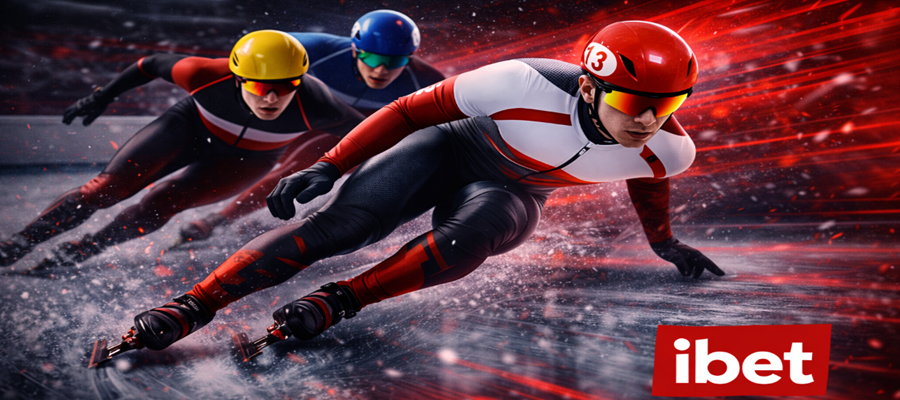
Short track speed skating is chaos on ice. Eight skaters launch into a 111-meter oval at speeds hitting 50 km/h, jockeying for position through razor-tight corners where one wrong lean can take down half the field. Favorites crash out in semifinals. Gold medal races get decided by referee reviews. A skater leading with three laps to go can finish fourth after a single inside pass on the final corner. And that’s exactly why short track speed skating betting creates some of the most compelling (and volatile) opportunities at the Winter Olympics.
Short track is knockout racing where tactics matter as much as speed, where starting position can determine medal outcomes, and where penalty rates and crash risk are quantifiable variables that most casual bettors ignore completely. The format produces variance. However, variance isn’t randomness. It’s opportunity!
Milano Cortina 2026 has already delivered drama: the Netherlands swept all four individual gold medals contested so far, Steven Dubois took Canada’s first men’s 500m gold since 2010, and South Korea reclaimed their women’s 3000m relay throne. With the men’s 5000m relay and women’s 1500m still to come, the tournament is far from settled.
At ibet, you can bet on different markets for every event, and if you understand how short track actually works, the edges are there.
Short Track Speed Skating Betting Promo at ibet
Before you lock in any short track bets, maximize your value with ibet’s Winter Olympics promotions and sports betting deals. Complete the Winter Olympics 2026 Free Bet Challenge and claim a €10 free bet.
Check our promotions page to access the latest betting promos and terms. And if you’re interested in betting on other Winter Olympics events at Milano Cortina 2026, including men’s ice hockey and curling, check out our betting news blog for comprehensive guides and daily updates.
What Is Short Track Speed Skating Betting and Why It’s Different
Short track speed skating takes place on a 111.12-meter oval carved into a standard ice hockey rink (60m x 30m). Unlike long track speed skating, where skaters race against the clock in separate lanes, short track is head-to-head knockout racing. Heats feed into quarterfinals, quarterfinals into semifinals, and semifinals into the medal finals. Five skaters typically compete in 500m and 1000m races; seven line up for the 1500m.
There are no lanes. Skaters can pass on the inside or outside at any time, which means positioning, timing, and reading your opponents’ moves matter as much as raw speed. The inside line through corners is shorter, so starting position and first-corner advantage create measurable edges. The tight turns and high speeds produce frequent crashes, and penalties for impeding, blocking, or dangerous skating are common enough that they’re a structural part of handicapping, not just bad luck.
The sport features nine Olympic events at Milano Cortina 2026:
Men’s Short Track Speed Skating Betting Events
- 500m
- 1000m
- 1500m
- 5000m relay
Women’s Short Track Speed Skating Betting Events
- 500m
- 1000m
- 1500m
- 3000m relay
Plus the mixed 2000m relay. The entire competition runs across six days, which creates schedule density issues as top skaters contest multiple distances and relays in quick succession, making fatigue a real variable in late-event performances.
Short Track Speed Skating Betting Distance Profiles
500m (4.5 laps): Dead sprint where starting position and first-corner execution dominate. High variance. A strong start can control the race; a bad one is almost impossible to recover from. This is the most tactical distance because there’s minimal time for passing and everything happens in the first two corners.
1000m (9 laps): The balance point between tactics and speed. Multiple passing opportunities exist, and skaters who conserve energy early can attack late. Research shows that ‘skate-from-the-front’ strategies (leading through the final seven laps) win about one in four races at this distance.
1500m (13.5 laps): Endurance grind that rewards stamina and late-race positioning. Skaters who sit in second or third with four laps remaining have the best win probability. Meaning they’re close enough to strike but conserving energy while the leader does the work.
Relays: Four-person teams where exchanges can happen at any time except the final two laps. The exchange involves a push from behind to transfer momentum, and relay chemistry. For example, how smoothly teams execute exchanges under pressure, is often the difference between gold and fourth. South Korea has won six of nine women’s Olympic relays. Canada has won four of seven men’s relays. That depth and continuity matter.
The Tactical Foundation: Why the Savviest Skater Often Wins
Short track racing is often won by the savviest skater, not the fastest. A pure sprinter who can’t read positioning will get boxed out. A tactically sharp skater who knows when to lead, when to sit, and when to attack can control races against technically superior opponents.
The two primary tactical templates are: lead from the start and force everyone else to work harder to pass you, or conserve energy and strike late when others have burned their legs chasing.
For the 500m, most winners use the first template as there’s no time to sit and wait. For the 1000m and 1500m, the second template appears more often, especially when multiple elite skaters are in the same heat and nobody wants to do all the work.
Passing: Inside vs Outside and What It Costs
An inside pass is lightning-fast (squeezing through a tiny gap on the apex of a corner) but it requires perfect timing and risks contact that can draw a penalty. An outside pass requires more speed and takes longer to execute because you’re skating a wider arc, but it’s safer from a rules perspective. Defensive skaters will take wide lines through corners to build speed and make inside passes nearly impossible, forcing attackers to go around.
What this means for betting: skaters with strong inside-passing reputations tend to finish better in chaotic, multi-lead-change races where positioning is tight. Skaters who rely on outside speed are more consistent in races where they can establish clear gaps. Both styles work, but in different race contexts, and that context is often visible from heat results before the final.
Starting Position and First-Corner Advantage
The inside starting position is a measurable advantage. The inside line through the first corner is shorter, and controlling that position early often means controlling the race. In 500m events especially, where everything is decided in seconds, starting on the inside significantly increases medal probability. Lane draws are randomized, but once they’re published, odds should adjust, and they don’t always move fast enough.
The Bottom Line: Tactical awareness is a pricing variable. Skaters who consistently get to the front early, maintain position through the middle laps, and defend the inside line in the final corners win more often than raw speed predicts. If the public is betting names and recent times, you can bet tactics and positioning trends.
Current Elite Athletes: Who’s Dominating Milano Cortina 2026
Milano Cortina 2026 has been defined by one storyline so far: the Netherlands’ unprecedented dominance. A country that had never won an Olympic short track medal before 2018 just swept all four individual gold medals contested to date. That’s not a fluke; that’s a program that’s built depth, tactics, and physiological profiling into a medal machine.
Men’s Standouts
Steven Dubois (Canada) – Won men’s 500m gold at Milano Cortina, giving Canada their first Olympic gold in that event since 2010. Dubois is now a five-time Olympic medalist (bronze in Beijing 2022, plus relay medals). He’s a tactical 500m specialist who excels at first-corner positioning and defending the inside line. If he draws an inside start, his win probability spikes.
Jens van ‘t Wout (Netherlands) – Gold in both 1000m and 1500m at Milano. Made the podium in all three individual men’s races, which is an absurd consistency achievement in a sport this volatile. His 1000m final was a masterclass in skate-from-the-front tactics—he led from lap three and never let anyone close enough to attempt a pass.
Melle van ‘t Wout (Netherlands) – Jens’s younger brother. Returned from a two-year injury layoff to win silver in the 500m. The van ‘t Wout brothers’ medals mark the Netherlands’ first-ever individual men’s short track Olympic medals. Together with Jens’s double gold, the family story has dominated the Games narrative.
William Dandjinou (Canada) – Two-time Crystal Globe winner (season-long World Tour champion) and World 1500m champion. Entered Milano as the betting favorite in all three individual men’s events but finished without individual medals due to penalties and positioning issues in key races. That variance—favorites getting penalized or boxed out—is structural to short track, not bad luck.
Women’s Standouts
Xandra Velzeboer (Netherlands) – Won gold in both the 500m and 1000m at Milano Cortina 2026, demonstrating genuine multi-distance dominance. Velzeboer’s ability to win across distances makes her especially dangerous in relays, where she can anchor any leg. She’s now the face of Netherlands short track and the early favorite for 2030 Olympic golds.
Courtney Sarault (Canada) – Won silver in the women’s 1000m at Milano. Made the podium in nine of her 12 races on the 2025 World Tour and secured her first Crystal Globe trophy. Sarault is tactically sharp and benefits from Canada’s deep women’s program, which produces consistently strong relay performances that inflate individual skater confidence.
Arianna Fontana (Italy) – The most decorated short track skater of all time with 11 Olympic medals. Carried Italy’s flag at the Beijing 2022 opening ceremony and is competing at home in Milano Cortina. At 34, she’s no longer the outright favorite in individual events, but her experience in high-pressure finals and her ability to read positioning make her a consistent podium threat.
Kristen Santos-Griswold (USA) – 2024 World Champion and 2024 Crystal Globe winner. Finished just off the podium in multiple Milano events but remains one of the strongest American short track skaters in history. Her tactical patience in the 1500m makes her a value bet in longer-distance matchups against pure sprinters.
Country Dominance and Medal Patterns: Who Has Depth
Historically, South Korea has led Olympic short track with 53 total medals (26 gold), followed by China (12 gold, 16 silver, 9 bronze) and Canada (10 gold, 13 silver, 14 bronze). The sport has long been dominated by East Asian programs with deep infrastructure and tactical coaching systems that most Western countries couldn’t match—until recently.
Milano Cortina 2026 has marked a genuine shift. The Netherlands, which entered these Games with minimal short track Olympic pedigree, has collected more individual golds in one Olympics than in all of their previous Olympic appearances combined. South Korea reclaimed the women’s 3000m relay gold from the defending champion Netherlands, but the Dutch have fundamentally altered the competitive landscape in individual events.
Why country programs matter for betting: Relay odds are heavily shaped by team depth. A country with three or four legitimate medal threats across distances has better relay chemistry, more tactical flexibility in exchanges, and higher podium probability than a country with one star and three support skaters. South Korea’s women and Canada’s men have won relays consistently not because of individual brilliance, but because of systematic depth and exchange execution under pressure.
The Bottom Line: Netherlands’ rise is real and data-supported. South Korea and China remain dangerous in relays. Canada is the most consistent men’s program. When betting relay markets, bet programs with 3-4 strong skaters, not just one superstar.
Rules, Penalties and Why Variance Is Structural
Short track’s rules create the variance that defines the sport—and also create betting edges for anyone who tracks penalty rates and disqualification history. Athletes can be disqualified for impeding (deliberately blocking or pushing another competitor), false starts (each skater is allowed one; a second false start = disqualification), kicking out (deliberately extending a leg to trip or endanger another skater), or off-track violations (skating outside the designated track boundaries).
The Card System and Tournament-Wide Consequences
A yellow card is shown for unsafe or hazardous fouls. It disqualifies the skater from that race and the remainder of that event, forfeiting all results from previous rounds. Two yellow cards equal one red card, which excludes the skater from the entire tournament—all remaining events, including relays.
This system creates compounding risk for aggressive skaters. A yellow card in the 500m heats eliminates that skater from 500m medal contention and puts them one card away from losing their 1000m, 1500m, and relay opportunities. Conservative tactics become rational when a skater has already received one yellow—and that shift in behavior can be priced into later-event odds if you’re tracking card accumulation.
Why Crashes and Penalties Create Real Edges
Crashes are common. Racing in packs of four to eight at high speeds on tight turns means falls happen regularly—sometimes from contact, sometimes from lost edges on corners, sometimes from one skater’s mistake taking down three others. Favorites can be eliminated in semifinals before they ever reach the final. Multiple disqualifications in finals can promote B-final skaters to the medals.
Here’s the key: crash risk and penalty rates aren’t random. Some skaters have aggressive inside-passing styles that draw more impeding calls. Some skaters lose their edges on corners more often under fatigue. Some nationalities have historically higher disqualification rates in specific events. All of this is trackable, quantifiable, and rarely priced correctly into pre-race odds.
The Bottom Line: Short track isn’t a lottery. It’s a high-variance sport where the favorites still win more often than not—but where understanding penalty risk, crash probability, and tactical discipline separates sharp bets from public money.
Why Short Track Is the Most Volatile Winter Olympics Betting Market
Short track speed skating produces more medal-flipping outcomes than any other Winter Olympics sport. Favorites crash. Penalties reverse results. A skater leading with one lap to go gets passed on the final corner and finishes fourth. That volatility scares casual bettors—but it’s exactly why the market creates edges.
The format is structurally volatile: knockout rounds mean every race is elimination stakes, crashes can take down multiple skaters simultaneously, and referee decisions can promote or demote athletes after the finish line. But volatility isn’t the same as unpredictability. The skaters who consistently reach finals, avoid disqualifications, and execute under pressure win medals at rates far higher than the odds imply—because the public overweights recent results and underweights tactical consistency.
Schedule Density and Fatigue Angles
Nine events over six days creates real fatigue risk for skaters competing in multiple distances. A skater who races 500m heats and finals early in the tournament, then moves into 1000m quarterfinals the next day, then contests 1500m semifinals 24 hours later is managing cumulative muscle fatigue that affects late-race positioning and sprint capability. The relays come at the end of the schedule, when legs are heaviest.
The betting edge: skaters who specialize in one distance are fresher in that event than multi-distance competitors. If a favorite has already raced three times in 48 hours and is facing a rested specialist in a semifinal, the odds often haven’t adjusted for the fatigue differential.
Recency Bias and Media Hype
Media coverage leans heavily on recent World Cup results, but short track specialists know that Olympic tactics differ significantly from World Tour racing. The knockout format, the card system’s tournament-wide consequences, and the medal stakes create different incentive structures. A skater who dominated the 2025 World Tour may not be the best Olympic bet if their aggressive style draws penalties or if they’re not used to managing multi-event schedules.
The Bottom Line: Volatility creates opportunity. The public bets names and recent headlines. Sharp bettors bet tactical profiles, penalty histories, and fatigue-adjusted performance under knockout pressure.
Betting Strategy: Where Value Appears in Short Track Markets
The most consistent edges in short track betting come from understanding three things the public undervalues: tactical discipline, penalty risk, and relay chemistry.
Tactical Discipline: Bet Positioning Over Speed
Pure speed doesn’t win short track races as often as positioning and timing do. Skaters who consistently get to the front early, defend the inside line through corners, and avoid risky inside passes in crowded packs finish on the podium more often than their raw time-trial speeds would predict. If you’re betting semifinals or finals, review the heat results and look for skaters who controlled position rather than just posted fast times.
Penalty Risk: Fade Aggressive Styles in High-Stakes Rounds
Skaters with aggressive inside-passing styles and histories of impeding penalties are higher-variance bets. In early heats, that aggression can pay off—there’s less at stake, and referees are sometimes more lenient. In semifinals and finals, referees are hyper-aware of contact, and a single impeding call ends the race. If a skater has received a yellow card earlier in the tournament, their tactics often shift more conservative—and that behavioral change can create value on opponents.
Relay Chemistry: Bet Programs, Not Stars
Relay odds are often set as if the best four individual skaters form the best relay team, but relay success is about exchange execution and team chemistry under pressure. South Korea’s women have won six of nine Olympic relays not because they always have the four fastest skaters, but because they execute exchanges cleanly and avoid the exchange-zone penalties that eliminate less-experienced teams. Canada’s men are similar—systematic depth and practiced exchanges beat star power.
The Bottom Line: Short track rewards disciplined tactical skaters over pure speed, penalizes aggressive risk-takers in high-stakes rounds, and favors deep programs over individual stars in relays. The public bets the opposite.
Milano Cortina 2026: Short Track Speed Skating Betting Events Still to Come
The men’s 5000m relay and mixed 2000m relay are still to be contested at Milano Cortina 2026, offering two final betting opportunities in the short track schedule.
Men’s 5000m Relay
Canada enters as the defending Olympic champion and has won four of the last seven Olympic men’s relays. South Korea and China are both dangerous—South Korea’s tactical depth and China’s sprint speed make them genuine gold threats. The Netherlands, riding their unprecedented individual success, will be competitive but lack the relay pedigree of the traditional powers.
The 5000m relay is 45 laps of controlled chaos. Teams can exchange at any time except the final two laps, and the push from behind during exchanges transfers critical momentum. Teams that execute smooth exchanges under pressure gain cumulative advantages that can be worth 2-3 seconds over the race distance. That’s often the difference between gold and fourth.
Short Track Speed Skating Betting FAQ
What is short track speed skating?
Short track speed skating is head-to-head knockout racing on a 111.12-meter oval. Unlike long track’s time-trial format, short track features multiple skaters racing simultaneously with no lanes, where tactical positioning and passing strategies matter as much as speed. The sport includes 500m, 1000m, 1500m individual events plus team relays.
Why is short track speed skating betting so volatile?
The knockout format, frequent crashes, and penalty system create structural volatility. Favorites can be eliminated in heats or semifinals before reaching finals. Referee decisions can disqualify skaters after the finish line. A skater leading with one lap remaining can finish fourth after a single inside pass on the final corner. That variance is real—but it’s not random, and tactical discipline reduces it.
What makes the 500m different from the 1500m?
The 500m (4.5 laps) is a dead sprint where starting position and first-corner execution dominate—it’s the highest-variance distance. The 1500m (13.5 laps) is an endurance race where tactics and late-race positioning matter more than pure speed. Skaters who specialize in one distance often struggle in the other due to different physiological and tactical demands.
How do penalties work in short track?
A yellow card disqualifies a skater from that race and the remainder of that event. Two yellow cards equal one red card, which excludes the skater from the entire tournament. Common infractions include impeding (blocking or pushing), false starts (two allowed per skater), kicking out (dangerous leg extension), and off-track violations. Penalty risk is trackable and creates betting edges.
Which countries dominate short track speed skating?
Historically, South Korea leads with 53 Olympic medals (26 gold), followed by China and Canada. Milano Cortina 2026 has seen the Netherlands emerge as a dominant force, sweeping all four individual gold medals contested so far. For relay betting, bet programs with depth—South Korea’s women have won six of nine Olympic relays, Canada’s men have won four of seven.
Does starting position matter in short track speek skating betting?
Yes, especially in the 500m. The inside starting position is shorter through the first corner and provides a measurable advantage. Controlling the inside line early often means controlling the race. Lane draws are randomized, but once published, odds should adjust—and they don’t always move fast enough, creating value opportunities.