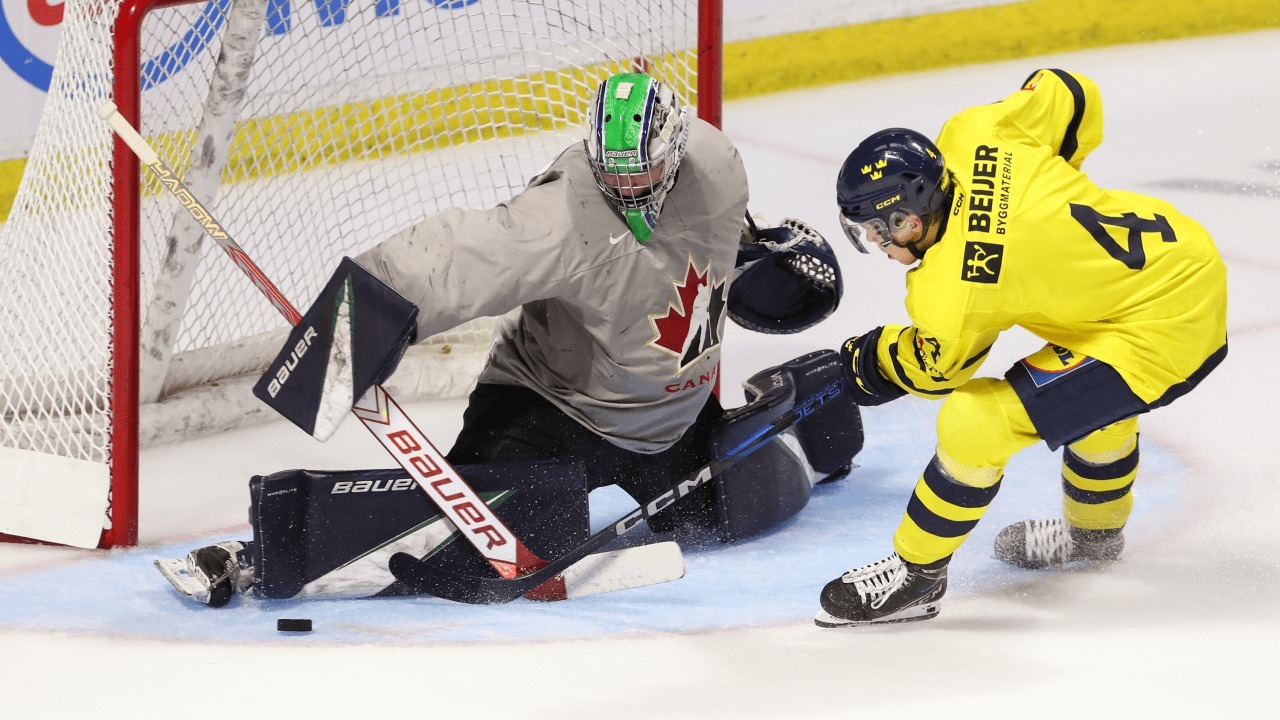
The World Junior Ice Hockey Championship returns to Minneapolis and Saint Paul this December 26 and until January 5. If you follow hockey seriously or bet on hockey, you already know why this tournament matters. If you don’t: welcome!
We’ll explain why two weeks in December command national attention in the world of hockey betting and why betting on it requires a fundamentally different approach than betting on regular-season NHL.
We’ll also go over the odds to win the WJC 2026 available at ibet and take a look at some of the favourites to win the gold medal. Don’t forget to check out our promotions page to make the most out of your hockey bets for the World Junior Ice Hockey Championship!
If you want betting picks for the World Junior Ice Hockey Championship 2026, check out our World Juniors 2026 article!
Editor’s Note: We’ve updated the article after the group stage, quarterfinals and semifinals took place, and ahead of the medal games scheduled for January 5.
World Junior Ice Hockey Championship 2026 So Far
Group stage delivered predictable winners: Sweden dominated Group A undefeated at 4-0-0, while Canada topped Group B despite early vulnerabilities. Finland stumbled through preliminary rounds, with losses to both Canada and Czechia relegated them to third place. The quarterfinals flipped the script entirely, though.
Finland eliminated defending back-to-back champion USA 4-3 in overtime, with Petteri Rimpinen posting a 28-save performance that signaled a return to elite form. Canada flexed offensive dominance with a 7-1 destruction of Slovakia. Czechia proved their rising status by beating Switzerland 6-2. The message was clear: group stage success doesn’t guarantee playoff advancement, and defensive systems trump talent in sudden-death hockey.
The World Juniors 2026 semifinals delivered the drama that defines this tournament. Sweden outlasted Finland 4-3 in a thrilling overtime shootout. Thus. the undefeated Swedes advance to the gold medal game with a hard-fought victory that proved their group stage dominance translates to playoff hockey. Meanwhile, in a stunning upset that shook the tournament, Czechia dismantled Canada 6-4 in a third-period collapse that will haunt the traditional powerhouse for years to come. Canada led 4-2 late in the third period but couldn’t contain Czechia’s relentless forecheck, allowing four unanswered goals in a devastating stretch that ended their gold medal dreams.
Now the stage is set for the final: Sweden faces Czechia in the gold medal game at the Grand Casino Arena in Saint Paul, while Canada and Finland battle for bronze at the 3M Arena at Mariucci in Minneapolis.
What Is the World Junior Ice Hockey Championship?
The IIHF World Junior Championship (WJC) is the top-ranking international competition for under-20 ice hockey players. Players must be under 20 years old in the calendar year the tournament ends. For example, this means that only players born in 2007 or later can compete in the 2026 tournament. However, players born in 2006 can compete if they haven’t turned 20 by December 31, 2025. Each national team fields 25 players: 14 forwards, 8 defensemen, and 3 goaltenders.
The tournament differs fundamentally from the senior IIHF World Championship (held in May annually for players of all ages). The World Championship showcases the best professional and semi-professional players globally and who are, typically, aged 23-35. The World Juniors exclusively features teenagers and young adults still developing their skills. This distinction matters because the World Juniors works as a proving ground for future NHL careers, not a platform for established professionals.
Why Is the World Junior Ice Hockey Championship Unique?
The WJC holds singular cultural and professional importance. Unlike senior international competitions, this tournament directly evaluates players aged 17-19 against their elite peers worldwide. For NHL scouts and team executives, the WJC provides crucial evidence of how prospects perform under extreme pressure. A strong WJC performance accelerates recruitment timelines and contract negotiations significantly. Data shows 94-96% of Canadian and American participants in recent tournaments get drafted or signed to NHL entry-level contracts within two years.
The tournament format also distinguishes it. The top ten nations compete in two groups of five, playing round-robin preliminary matches (December 26-31). Winners advance to single-elimination playoffs (quarterfinals, semifinals, gold/bronze medal games, January 2–5). Losers face relegation. This structure compresses the entire competition into eight days, which is actually shorter than the opening month of an NHL season. Short formats amplify variance. Hot goaltenders steal games. Defensive systems trump offensive depth. Momentum matters more than talent plenty of times.
Global Shift in the World Junior Ice Hockey Championship
The World Junior Ice Hockey Championship started officially in 1977. Canada and the Soviet Union dominated historically, combining for 33 of the first 49 gold medals. But competitive parity has shifted dramatically. Finland has won 5 golds, while Sweden has won 2. Czechia consistently wins medals.
While no single nation dominates now the way Canada did in the 1990s-2000s or the Soviet Union in the 1970s-1980s, the USA has managed to win back-to-back titles (2024, 2025).
This shift reflects global hockey development investment. Finland and Sweden run elite junior systems rivaling North America’s. Czechia produces elite talent consistently. Latvia upsets favored teams regularly. European defensive structures prove effective in short tournament formats. So, it’s safe to say that the era of assumed/North American superiority has ended.
The WJC 2026 Tournament at a Glance
- Dates: December 26, 2025-January 5, 2026
- Location: Minneapolis & Saint Paul, Minnesota
- Groups: 2 groups of 5 teams each
- Significance: 50th anniversary edition
WJC 2026 Winner Odds
Here are the odds to win the World Junior Ice Hockey Championship 2026, at ibet’s sportsbook:
| Country | Odds | Implied % |
| Canada | 2.45 | 40.8% |
| USA | 3.10 | 32.3% |
| Sweden | 4.75 | 21.1% |
| Finland | 8.50 | 11.8% |
| Czechia | 17.00 | 5.9% |
| Switzerland | 46.00 | 2.2% |
| Slovakia | 46.00 | 2.2% |
| Germany | 91.00 | 1.1% |
| Latvia | 141.00 | 0.7% |
| Denmark | 226.00 | 0.4% |
WJC 2026 Groups & Schedule
Group A (Saint Paul, Grand Casino Arena)
- USA (host)
- Sweden
- Slovakia
- Switzerland
- Germany
Group B (Minneapolis, 3M Arena at Mariucci)
- Finland
- Czechia
- Canada
- Latvia
- Denmark
WJC 2026 Tournament Format
In the World Junior Ice Hockey Championship, teams play four preliminary-round games (one against each group opponent) from December 26–31. The top four teams from each group advance to quarterfinals on January 2. Semifinals take place on January 4 and medal games on January 5.
Also, don’t forget to check our live betting platform during the games so you can get access to the latest in-game odds for the WJC 2026.
Key Group A Matchups
- Sweden vs Slovakia (December 26)
- USA vs Germany (December 27)
- USA vs Switzerland (December 27)
- Germany vs Sweden (December 29)
Key Group B Matchups
- Czechia vs Canada (December 26)
- Latvia vs Canada (December 27)
- Finland vs Czechia (December 29)
- Canada vs Finland (December 31)
Favourites to Win the WJC 2026
Canada (2.45 Favorites)
Canada has won 20 gold medals historically, the most ever in the history of the World Junior Ice Hockey Championship. They last won in 2023, but missed both 2024 and 2025. This absence cost them momentum and international experience. The younger generation has never competed at this level. Canada rebuilt the roster carefully. They possess quality depth, but whether that translates to gold remains an open question. A tight Group B (Czechia rising, Latvia capable of surprises) will test them early.
USA (3.10 – Defending Back-to-Back)
The USA won the World Junior Ice Hockey Championship in 2024 and 2025. For the WJC 2026, they play in their own country, in Minnesota. Research shows hosting in youth tournaments provides a statistically significant advantage of roughly a 10% edge over neutral sites. Defending back-to-back titles historically proves difficult. Three-peats almost never happen. Yet the USA has momentum, proven performance under pressure, and home ice. They face a weaker Group A (Germany, Slovakia, Switzerland lack the depth of Group B). USA will likely dominate the group stage.
Sweden (4.75 – Perennial Underachiever)
Sweden has won only 2 gold medals but 12 silver medals. They possess talent depth. Ivar Stenberg plays as a 2026 draft prospect with SHL experience. Also both Viggo Björck and William Håkansson should also draw some attention. Meanwhile, Anton Frondell can score at will. However, Sweden consistently fails to win gold when favored. Their system emphasizes skill over structure. Playoff hockey (tight defensive systems, every game elimination risk) punishes that approach. Sweden lacks an elite defenseman. Good defenders exist but do they currently have a dominant shutdown defenseman? Sadly, the answer is no.
At 4.75 odds, bettors are not getting much value.
Finland (8.50 – Value Play)
Finland has won 5 golds. They won most recently in 2019. Finland returned a silver medal in 2025 after losing to the USA in the gold medal game. That loss creates “unfinished business” motivation for 2026. Petteri Rimpinen returns as goaltender, thus providing experience at one of the most critical positions. He was the best young goalie in 2025. Emil Hemming returns as a scoring star. Aatos Koivu (son of Saku Koivu) provides depth. Aron Kiviharju plays defense as a Minnesota Wild prospect. On top of that, team Suomi will have youngsters like Juho Piiparinen and Oliver Suvanto.
Here’s why Finland offers value at 8.50 (11.8% implied): Finland’s strength lies in defensive structure and goaltending. Short tournament formats amplify goaltending variance. Defensive systems beat offensive talent when every team eliminates the loser. Public betting money favors Canada and USA. Finland’s approach gets underrated in the market. Group B placement (alongside Czechia and Canada) complicates their path, but a semifinal matchup could favor their style dramatically.
Czechia (17.00)
Czechia has emerged as a rising power. Nowadays, they medal consistently in the World Junior Ice Hockey Championship. But in Group B with Canada (experienced, expected) and Finland (tournament specialist), their path to the final narrows. At 17.00 odds, better value exists elsewhere.
World Junior Ice Hockey Championship Betting Angles
Group Stage Chaos
Teams rotate lineups in the group stage. Reserves play. Experimentation happens. Favorites often don’t dominate convincingly. Upsets occur. Latvia beat Canada multiple times in recent years. Latvia’s underdog status should not prevent you from considering them against weaker opponents.
Home Ice Advantage: A Real Edge
Research confirms that hosting in youth tournaments provides a significant statistical advantage. USA plays in their home country. Crowd noise affects young players more than professionals. Rink size differences matter (North American ice differs from European ice). USA will likely win Group A decisively.
Goaltending as Differentiator
In short formats like this, goaltending variance matters more than in 82-game seasons. Finland’s Rimpinen advantage becomes a betting edge. Canada’s goaltending situation remains less certain. USA has solid but less proven goalie depth. A hot goaltender can carry a team past superior rosters in playoff rounds.
Group Stage vs. Playoff Strategy
Group stage matches reward offensive systems. Finland and Czechia will struggle against wide-open opponents. Playoff rounds (sudden death) reward defensive structure. This dynamic shift matters for bet selection. Swedish teams tend to advance far but stumble defensively when it matters most.
World Junior Ice Hockey Championship All-Time Records & Historical Context
When it comes to the World Junior Ice Hockey Championship, Canada leads all nations with 20 gold medals. Russia/USSR won 13 before the Soviet Union dissolved. USA has 6. Finland has 5. Sweden has 2.
Peter Forsberg (Sweden, 1993) scored 31 points in a single tournament—a record that remains untouched 32 years later. Connor Bedard (Canada, 2023) scored 23 points at age 17, the most ever scored by a teenager. Eric Lindros accumulated 31 career points across multiple tournaments.
The 1987 “Punch-up in Piešťany” stands as the most infamous moment. Canada and the Soviet Union played for gold. Tensions boiled over. A bench-clearing brawl erupted. Both teams got disqualified. Finland won gold without playing in the final.
Jordan Eberle scored an overtime goal for Canada against Russia in the 2009 semifinal with five seconds remaining in regulation. TSN’s broadcast call became iconic. The moment defined a generation of hockey betting fans.
Latvia beat Canada multiple times in recent years which comes as a shock given Canada’s historical dominance. Czechia consistently medals now. Competitive parity has increased dramatically.
World Junior Ice Hockey Championship Betting Trends
Favorites Win Often But Not Always
Favorites win roughly 65-70% of gold medal games historically. But the group stage? Lower percentage. Canada has won roughly 50% of tournaments when favored. USA’s recent back-to-back momentum suggests continued success, but defending titles proves difficult.
Upset Patterns
European defensive teams beat North American offensive teams in short formats regularly. Group stage chaos (reserves playing) creates unpredictable results. Playoff hockey (sudden-death format) favors hot teams over superior rosters. Finland at 8.50 offers value betting if goaltending holds. Czechia at 17.00 offers less value given Group B placement. Latvia at 141.00 presents upset potential only.
Goal Scoring Trends
When it comes to hockey betting, youth scores are lower than in the NHL. Defensive emphasis in tournaments reinforces this. Recent tournaments trend toward tighter games. WJC 2026 will likely feature lower-scoring matchups overall. Under bets find more value than over bets.
Finland & Sweden In the World Junior Ice Hockey Championship
Sweden: Deep Talent, Inconsistent Gold
Sweden produces more talented individual players than Finland. But talent doesn’t guarantee gold in short formats. Sweden’s system emphasizes skill over structure. Playoff hockey punishes this. Sweden reaches semifinals regularly (12 silver medals vs 2 golds). Their goaltender (Love Harenstam, expected starter) has less proven pedigree than Finland’s Rimpinen. No elite defenseman leads the blue line. At 4.75, value exists on fading Sweden and backing their opponents offers better returns than backing Sweden for gold.
Finland: Tournament Specialists
Finland excels at the World Juniors despite a smaller population base. They win through defensive structure, not individual talent dominance. Their penalty kill leads leagues. Their defensive zone spacing remains tight. Goaltending depth provides consistency. They understand tournament hockey, where every game matters. Elimination risk forces defensive chess. Finland’s system embraces this reality. Public money ignores them at 8.50. Their true probability reaches 15%+ based on historical tournament performance.
WJC 2026 Final Thoughts
The World Junior Championship tests young hockey players under pressure. National pride, draft positioning, and individual legacies hang in the balance. This tournament separates players who thrive under elimination stress from those who don’t.
Canada arrives as favorites but faces questions. USA defends back-to-back at home. Finland and Czechia disrupt expected narratives. Sweden stumbles when structure matters. These dynamics create opportunities for informed bettors willing to fade consensus and embrace tournament-specific patterns.
The WJC 2026 edition marks the 50th anniversary. That milestone carries weight. But regardless of history, the tournament’s volatility remains its defining characteristic. Favorites bust. Underdogs surge. Goaltenders steal games. Defensive systems prevail. Now that you’re in the know, feel free to bet accordingly at
World Junior Ice Hockey Championship FAQs – Frequently Asked Questions
When exactly does the World Junior Ice Hockey Championship 2026 start?
December 26, 2025, with preliminary-round games. The gold medal game concludes on January 2, 2026.
How many games does each team play?
Four preliminary-round games (one against each group opponent). Advancing teams play additional knockout-stage games.
Can Canada win WJC 2026 after missing 2024 and 2025?
Possible. Canada possesses quality depth. But the younger generation remains unproven internationally. Group B placement (with Finland and Czechia) tests them early. Czechia and Latvia offer upset potential.
Will USA win three consecutive gold medals?
Defending titles proves historically difficult. Yet USA has momentum, home ice advantage, and proven performance under pressure. Group A competition (Germany, Slovakia, Switzerland) remains weaker than Group B.
Does Finland have a legitimate chance to win WJC 2026?
Yes. Finland operates as a tournament specialist. Goaltending excellence provides advantage in short formats. Motivation (2025 silver medal) matters. At 8.50 odds, Finland offers the best value for informed bettors.
Why does Sweden consistently underperform at the World Junior Ice Hockey Championship?
Sweden’s talent-based system struggles in playoff formats. Defensive structure beats individual skill in elimination hockey. Sweden lacks an elite defenseman. They reach semifinals often but lose when structure matters most.
What’s the biggest upset potential?
Finland over USA in a potential semifinal. Defensive goaltending-focused style could neutralize American offensive firepower. Czechia over Canada in Group B remains possible early.
How does home ice advantage affect hockey betting?
Hosting provides a statistically significant edge in youth tournaments. USA’s Minnesota advantage boosts their win probability by roughly 10%. European teams face travel fatigue and unfamiliar conditions. USA will likely dominate Group A.
What hockey betting edge exists for informed bettors?
Finland at 8.50 (11.8% implied probability) offers value if true probability reaches 15%+. Sweden at 4.75 presents fade value (bet against them). Goaltending becomes the differentiator in short formats—prioritize that in analysis.
All odds displayed on this page were correct at the time of writing and may have moved since the content was published. Betting markets shift constantly based on action and betting news. For the latest odds and current lines, visit the ibet Sportsbook.